Sizing is where most bulk overall orders go wrong, and it is almost always avoidable. The garment itself is simple, but “overalls” covers two different products with two different sizing systems, and a crew is a spread of body shapes rather than one average person. Get the measurements and the size run right up front and the order arrives ready to wear. Get them wrong and you are managing exchanges on garments that have already been embroidered with your logo, which is the most expensive way to learn a sizing chart.
This guide walks through the measurements that actually matter, how much room to leave, and how to plan quantities across a team so you are not stuck with a stack of smalls and not enough XLs.
Two garments, two sizing systems
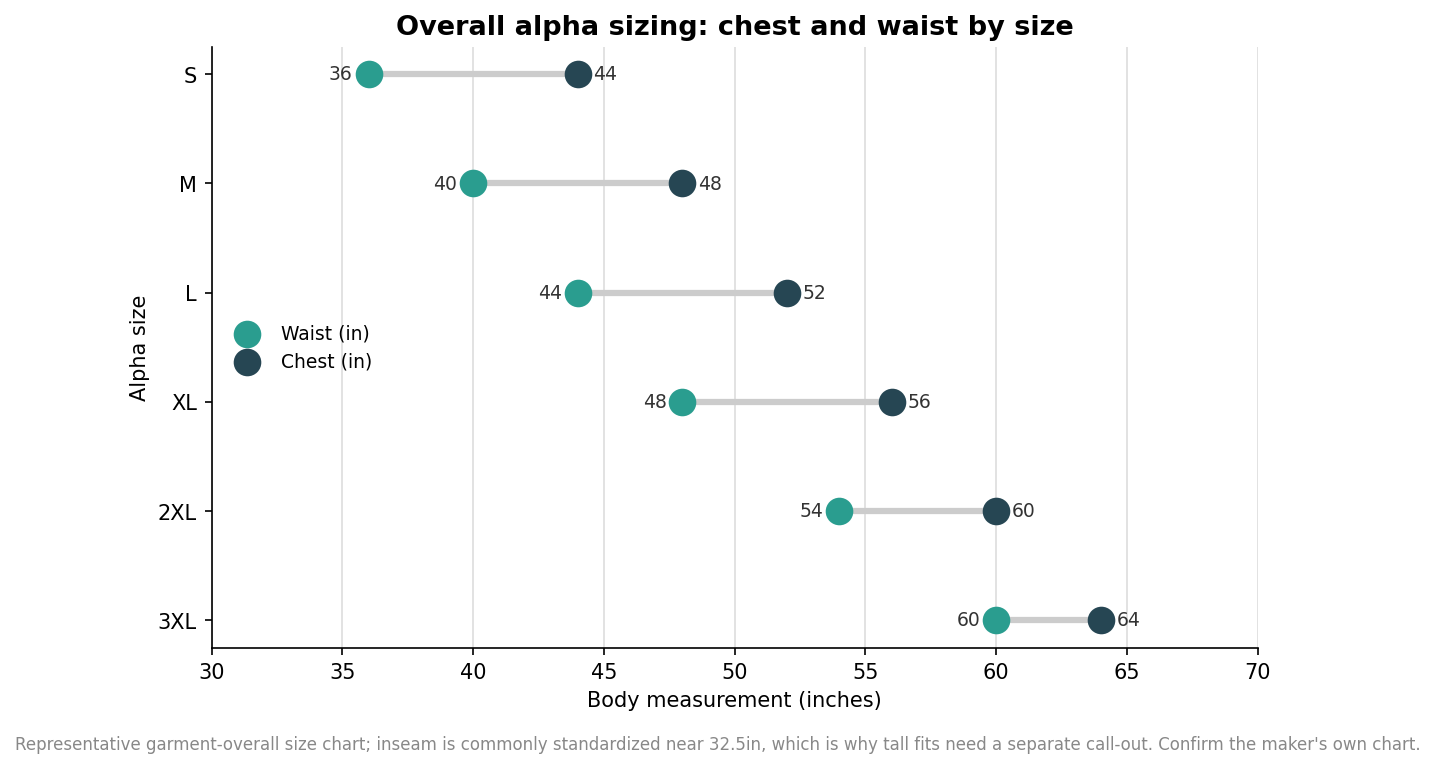
Bib and garment-style overalls typically use alpha sizing — S, M, L, XL and up — mapped to chest and waist measurements, with the leg length often held constant. A canvas overall such as AS Colour’s 5980 is a good example of this style: standard alpha sizes and a small set of colorways rather than a numeric fit. Full-body coveralls, sometimes called boiler suits, more often use numeric sizing tied to chest size, roughly 32 through 54 for men, because a one-piece garment has to fit the torso and the legs together. The distinction matters because a worker who is a “Large” in a bib overall is not automatically a “44” in a coverall, and ordering off the wrong system is a common first mistake.
The chart below shows how a representative alpha size run maps chest and waist in inches. Notice that the gap between chest and waist narrows at the larger sizes, and that leg length is standardized. That standardized inseam, commonly around 32.5 inches, is exactly why taller workers need a separate tall fit rather than just a bigger size, since sizing up adds girth but not length.
The four measurements that actually matter
Chest is the primary number: measure around the fullest part, under the arms and across the shoulder blades, keeping the tape level and snug but not tight. Waist comes next, taken at the natural waistline above the hips, with the tape parallel to the floor. Inseam runs from the crotch down the inside of the leg to just above the shoe, and it is what keeps hems from dragging or bunching. For one-piece coveralls, add a fourth: torso length from the base of the neck to the crotch, because a boiler suit that is roomy in the chest but short in the body will pull uncomfortably every time someone bends or reaches overhead.
Two allowances turn those raw numbers into a garment people can actually work in. If the overall will be worn over regular clothes or a base layer, add roughly two to four inches (about 5 to 10 cm) to the chest and waist before choosing a size. For heavy-duty jobs with a lot of stretching, kneeling, and overhead work, sizing up one step buys mobility that a tight fit will not. And avoid the classic errors: do not measure over bulky clothing, do not have people guess or measure themselves alone, and always check the specific maker’s chart rather than assuming every brand’s Large is the same, because they are not.
Buying for a crew: build a real size run
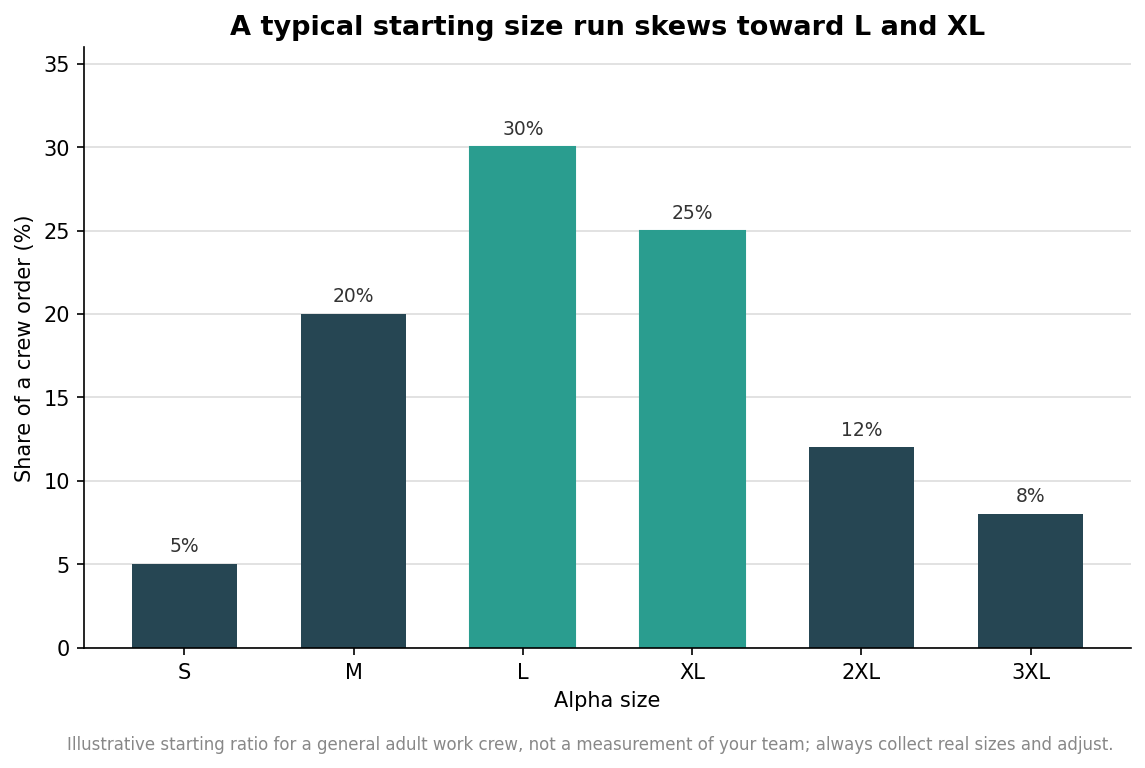
The single biggest ordering mistake is splitting a quantity evenly across sizes. Real crews cluster in the middle and skew toward the larger end, so an even split leaves you short on the sizes most people need and long on the ones almost nobody does. A better approach is to collect actual sizes from every person before ordering. When that genuinely is not possible — a rush order, or garments bought ahead for future hires — start from a weighted curve rather than a flat one and adjust to what you know about your team.
The chart below shows an illustrative starting ratio for a general adult work crew, weighted toward Large and Extra Large. Treat it as a first draft, not a rule: a warehouse team, a welding shop, and a landscaping crew will each pull the curve in a different direction. Whatever the mix, order a small buffer over your exact headcount so a new hire or a miscounted size does not force a second run, and confirm the supplier can reorder individual sizes later rather than only in full packs.
Prove the fit before you commit to decoration
Because branding is applied after the blank is made, a wrong size is far more costly on a custom order than on a plain one. An embroidered or printed overall usually cannot be resold or returned the way an undecorated one can, so the fit has to be right before the decoration goes on. The cheapest insurance is to order a size set or a few samples first, have a representative range of your team try them on over their normal work clothes, and lock in the chart you will actually order against. It costs a little time and a couple of sample garments, and it removes the expensive surprise.
Build the timeline to allow for it. Custom overalls and coveralls are typically made and decorated to order with lead times running a couple of weeks or more, longer in busy seasons, so a fit-check sample adds a step you want to schedule rather than skip. Sort out sizing while the artwork is still being finalized, and the two tracks finish together instead of the fit problems surfacing after every garment already carries your name.